ARLINGTON COUNTY, VA HISTORY AND LOOKUP
Table of Contents
- In-Print County History Books
- Free Public Domain County History Books
- Related Books
- Concise County History
- Comments & Suggestion
In-Print County History Books
These titles are currently in print and selected for their relevance to local and county history. Click anywhere on the book listing below, each listing links directly to the book’s purchase page.

Arlington County Chronicles
Modern-day Arlington County is a center for government institutions and a critical part of the Washington, D.C. community. But the identity of the area goes far beyond the influence of the nation’s capital. During the War of 1812, the original copy of the Declaration of Independence was hidden from the British in a local area gristmill. Arlington was the only county in Virginia to vote against secession, despite being home to Robert E. Lee. In the 1950s, a young Jim Morrison was raised partly in Arlington.

Lost Arlington County
Illustrated local history that chronicles Arlington County’s evolution from its roots as farmland in Alexandria County to a dynamic suburb of Washington, D.C., highlighting long-forgotten homes, businesses, institutions, and cultural markers along the way. Through engaging vignettes and historical snapshots, Clark preserves the memory of the county’s past and provides readers with a deeper understanding of the forces that shaped its identity.

Remembering Arlington
Arlington County evolved from a “sleepy Southern town” and a mere neighbor to Washington, D.C., into a thriving suburban community as transportation improved and an influx of government workers settled in the area. In Remembering Arlington, Matthew Gilmore presents a compelling historical retrospective with vivid black-and-white photographs capturing the county’s growth, local businesses, parades, and the transformation of its landscapes from the 19th century through the 1970s.

Arlington: 175 Years
In 1834, Robert Hurd and his family settled on a parcel of land in what is now present-day Arlington. A devout Presbyterian, Hurd named the town after his favorite church hymn. In the late 1800s, the small town of Arlington saw progress in the form of two railroads. The mid-1930s were especially prosperous, as the town enjoyed a bustling business center that included six grocery stores. The famous Arlington Homecoming Festival began in 1946 and ran for 50 years. In the 1990s, George Herbert Bush and William Jefferson Clinton made presidential campaign stops here, making history in this quiet, small town.
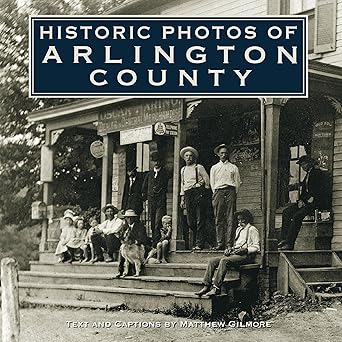
Historic Photos of Arlington County
Arlington County transformed from a quiet, overlooked neighbor of Washington, D.C., into a bustling suburban community as improved transportation and incoming government workers shaped its growth. Historic Photos of Arlington County offers a vivid visual journey through the county’s history, showcasing black-and-white images of rural landscapes, neighborhoods, parades, and landmarks like the Tomb of the Unknown Soldier.
Free County History Books
This section features a curated collection of county history books sourced from public domain archives. Each book provides valuable insights into local history and heritage. Click anywhere on the book listing below, each listing links directly to the book’s public domain resource.

A History of Arlington County, Virginia by Dorothy Ellis Lee, 1946 – 181 Pages
A comprehensive local history that explores the people, places, and events that shaped Arlington County from its earliest settlement through modern times. It blends narrative storytelling with historical research to offer readers insight into the cultural and political development of this significant Virginia community.
Related Books
This section highlights additional county and local history titles that complement the main collection. These books are selected for their relevance, historical value, and research usefulness. Click anywhere on the book listing below, and each listing links directly to the corresponding resource or purchase page.
Book Title TBD
This book is still being located or processed. Details will be added once available.
Arlington County, Virginia: A Genealogical Overview
Located in Northern Virginia across the Potomac River from Washington, D.C., Arlington County is an area uniquely intertwined with the history of the United States. For genealogists, its past is defined by its origins as part of the nation’s capital, its close ties to the federal government, and its significant role during the Civil War.
I. County Formation and Evolution
Arlington’s complex history of name changes and shifting boundaries is a critical piece of information for researchers tracing family lines in this metropolitan region.
- Year of Creation: The area was originally ceded by Virginia in 1790 to become part of the District of Columbia. In 1846, the land was retroceded to Virginia and officially became Alexandria County in 1847. It was renamed Arlington County in 1920 to reduce confusion with the independent City of Alexandria.
- Parent County: The land that became Arlington County was originally part of Fairfax County. Researchers seeking records that pre-date 1790 must consult the records of Fairfax County.
- Original Territory & “Daughter” Cities: When established as Alexandria County, its territory included the area that is now the independent City of Alexandria. The City of Alexandria was separated from the county in 1870, creating a significant division of records. The town of Falls Church, once within the county’s borders, also became an independent city in 1948. Anyone whose ancestors lived in what is now the City of Alexandria or the City of Falls Church before these separations may find their records in Arlington County’s archives (formerly Alexandria County).
- Boundary Changes: The most significant boundary changes were the 1846 retrocession from the District of Columbia, the 1870 separation of the City of Alexandria, and the 1948 separation of the City of Falls Church. After 1948, the county’s boundaries have remained largely stable.
- Bordering Jurisdictions:
- Fairfax County (west and southwest)
- City of Falls Church (west)
- City of Alexandria (southeast)
- Potomac River, with Washington, D.C. on the opposite shore (north and east)
II. Settlement and Early History
- Early Inhabitants: Before European colonization, the area was inhabited by the Necostin (or Anacostan) people, a tribe of the Piscataway paramount chiefdom, who lived along the Potomac River. As English settlement expanded, these native populations were displaced.
- First Pioneers and Settlement: English settlement in the broader region began in the late 17th and early 18th centuries. The land was part of the vast Northern Neck Proprietary granted by King Charles II. George Washington’s family had significant landholdings in the area, and in 1785, George Washington Parke Custis, his step-grandson, acquired the land that would become the Arlington estate. The society that developed was based on agriculture, with notable estates like Arlington House. The area’s proximity to the newly planned federal city of Washington in the 1790s spurred its initial development.
- Civil War Significance: Arlington County’s strategic location directly across from the capital made it critically important during the Civil War. Immediately after Virginia seceded in May 1861, Union troops crossed the Potomac, occupied the county, and seized the Arlington estate of Mary Anna Custis Lee, wife of Confederate General Robert E. Lee. The heights were fortified to defend Washington, D.C., resulting in the construction of a series of forts, including Fort Corcoran and Fort Whipple (part of today’s Fort Myer). Arlington House itself was repurposed as a Union Army headquarters. In 1864, the grounds were officially designated as a national cemetery, in part to prevent the Lee family from ever returning. This marked the beginning of Arlington National Cemetery, the nation’s most hallowed burial ground.
III. Genealogical Records and Resources
This section provides the practical information needed to locate ancestral records for Arlington County.
- County Seat: The county seat is the Courthouse neighborhood in Arlington.
- Record Loss & Preservation: Arlington County’s records are generally intact. Unlike many Virginia counties, it did not suffer major record loss during the Civil War, as it was under Union control for the entirety of the conflict. However, researchers must be mindful of the jurisdictional changes. Records from before the 1846 retrocession may be found in the District of Columbia archives or with Fairfax County. Records pertaining to residents of the City of Alexandria after 1870 are held by that city.
- Location of Records:
- Arlington County Circuit Court Clerk’s Office: Located at 1425 N. Courthouse Road, Arlington, VA 22201. This is the central repository for the county’s historical records since its 1847 formation as Alexandria County. This includes deeds, wills, court orders, and marriage records.
- Center for Local History, Arlington Public Library: Located at the Central Library (1015 N. Quincy Street), the Center for Local History is an exceptional resource for genealogists. It holds a significant collection of materials including photographs, maps, oral histories, local government records, and information on community organizations and families.
- Vital Records:
- Birth and Death Records: Statewide registration in Virginia began in 1853 (continuing until 1896, and resuming in 1912). These records are held at the Arlington County Circuit Court Clerk’s Office and the Virginia Department of Health, Division of Vital Records in Richmond.
- Marriage Records: Marriage records from 1847 onward are available at the Circuit Court Clerk’s Office.
- Libraries with Genealogy Collections:
- Arlington Public Library’s Center for Local History: As mentioned above, this is the primary local resource for genealogical and historical research in Arlington.
- The Library of Virginia: Located in Richmond, this is the state’s main archive and an essential resource. It holds materials that supplement county records, including tax lists, land patents, military records, and records from the District of Columbia era that may pertain to Arlington ancestors.
This county history was generated by AI and may be inaccurate or incomplete; please verify important information independently.